
Claude Code
Claude Code
Claude Code
Claude Code v2.1.278 Update: AGENTS.md, Projects & Auto Mode (2026)
Claude Code v2.1.278: What’s New in Anthropic’s Latest AI Coding Update (2026)
Anthropic has rolled out Claude Code v2.1.278, released on September 19, 2026, and it’s one of the more practical updates the coding agent has seen this year. Instead of one flashy headline feature, this release quietly fixes a billing pain point, adds a long-requested compatibility feature, and folds in a bigger structural change — Claude Code Projects — that shipped just two days earlier. If you’re a developer, a startup founder, or a business running AI automation workflows on top of Claude, here’s exactly what changed and why it matters.
A Quick Recap: What Is Claude Code?
Claude Code is Anthropic’s command-line AI coding assistant. Developers use it to write, debug, and refactor code, run terminal commands, manage git workflows, and — increasingly — supervise multiple AI agents working on a codebase at once. It’s become a core part of many AI-first development stacks, and version 2.1.278 pushes that “agent supervisor” direction further.
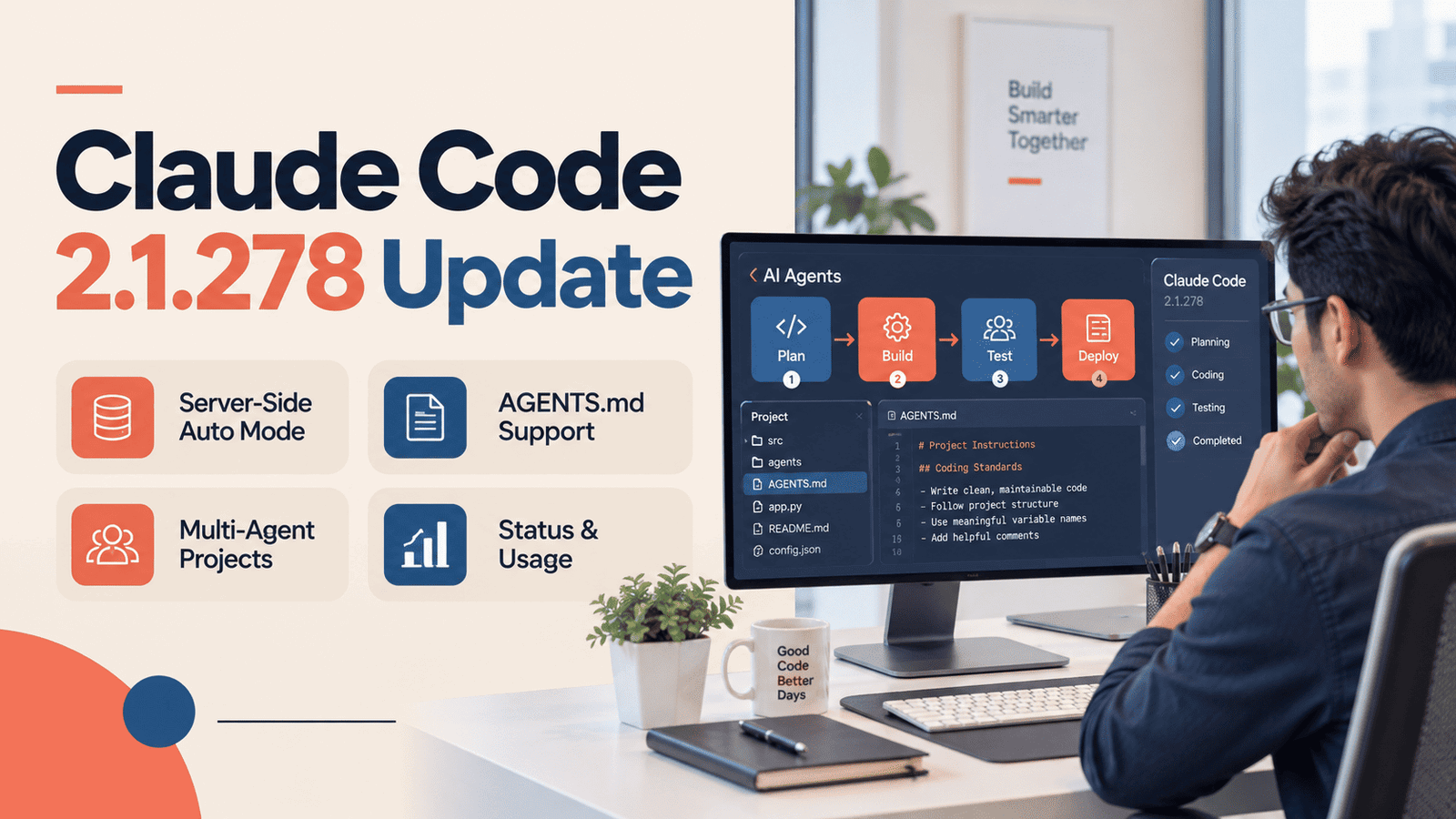
1. Server-Side Auto Mode Classifier (No More Extra Charges)
The biggest under-the-hood change in this release is how auto mode handles its safety checks. When Claude Code runs in auto mode, a classifier reviews actions like shell commands and network requests before they execute, to catch anything risky.
Previously, this classifier ran as a separate request that added to your usage bill. Starting with v2.1.278, auto mode now defaults to a server-side classifier on Enterprise plans, Claude API accounts, Claude Platform on AWS, Amazon Bedrock, Google Cloud’s Agent Platform, and Microsoft Foundry — and Anthropic does not charge for this classifier overhead when the server performs the check. If your session’s platform doesn’t support server-side checks yet, Claude Code quietly falls back to its own classifier requests (billed as before) and shows a one-time notice.
For teams running Claude at scale, this is a real cost optimization — one less line item eating into your token budget every time an agent runs autonomously.
2. Status Bar Now Shows Classifier Status
To make the above change visible, Claude Code added a new Auto mode server row to the /status command. Run /status inside any session and you’ll now see whether the classifier checks for that session are running on Anthropic’s servers (Enabled) or have fallen back to local billing (Disabled). It’s a small addition, but it removes the guesswork around whether you’re being charged for classifier overhead.
3. AGENTS.md Support — A Big Win for Cross-Tool Teams
This is the feature developers have been asking for the most. Claude Code has always looked for a CLAUDE.md file to load project-specific instructions — coding standards, architecture notes, style rules. The problem: other AI coding tools like Cursor, Codex, and Amp use a different, increasingly standard filename, AGENTS.md, and teams using multiple tools had to maintain duplicate instruction files.
As of v2.1.278, Claude Code reads AGENTS.md as a fallback whenever a project doesn’t have a CLAUDE.md in that directory. If both files exist, CLAUDE.md still takes priority — nothing changes for existing Claude-only projects. But for teams juggling multiple AI coding assistants across a repo, this removes a genuine friction point and makes Claude Code play nicer inside mixed toolchains. It’s a small technical change with a big practical impact on how teams standardize AI in automation across their dev stack.
4. Claude Code Projects: Supervising Multiple Agents at Once
The headline structural change bundled into this release cycle is the redesigned Claude Code Projects feature. Rather than treating a “project” as a static folder of context, Projects now acts as a persistent coordination layer — it remembers the overall goal of a codebase and distributes work across multiple parallel Claude Code sessions running in the cloud.
In practice, this means a developer (or a small startup team) can launch several coding agents against related tasks in the same project, track their progress from one place, and let Claude Code coordinate the handoffs — rather than running separate, disconnected terminal sessions and manually stitching the results together. It’s part of a broader industry shift toward “agent teams” rather than single-agent tools, something we’ve been tracking closely as AI is evolving in layers, from rule-based systems to fully autonomous agents.
How to Update Claude Code
Updating is straightforward. Run:
npm update -g @anthropic-ai/claude-codeOr check the official Claude Code Quickstart Guide for platform-specific installation steps. Since server-side classifier checks and AGENTS.md support are both new defaults, it’s worth re-running /status and /config after updating to confirm your session picked up the changes.
Why This Matters for Businesses Using AI Coding Tools
For agencies and startups building software with AI assistance, updates like this aren’t cosmetic — they directly affect cost, team workflow, and how fast you can ship. A free classifier means lower operating cost for auto mode-heavy workflows. AGENTS.md support means less duplicated setup work across tools. And Projects means small teams can supervise agent fleets the way larger engineering orgs already do. If your team is building an internal AI toolkit or learning to work with AI automation as a career skill, staying current with these release notes is genuinely part of the job now — not optional reading.
Anthropic ships changes to Claude Code frequently, and each release tends to compound: a classifier optimization here, a compatibility fix there, a structural feature like Projects layered on top. Version 2.1.278 is a good example of how incremental this progress usually looks in practice, even when the cumulative effect — cheaper, more standardized, more collaborative AI coding — is significant.
Conclusion
Claude Code v2.1.278 proves that meaningful AI tooling updates don’t always need a flashy launch — a free classifier, AGENTS.md support, and coordinated multi-agent Projects together make development faster and cheaper. For teams building on AI automation, staying current with releases like this is now a competitive advantage.
Claude Code v2.1.278 is a stable release of Anthropic's AI coding assistant, published on September 19, 2026. It introduces a free server-side auto mode classifier, AGENTS.md fallback support, a new /status row, and builds on the newly launched Claude Code Projects feature.
It was released on September 19, 2026, just two days after the redesigned Claude Code Projects feature went live on September 17, 2026.
It's a safety-check system that reviews risky actions — like shell commands or network requests — before Claude Code executes them automatically in auto mode. It exists to catch mistakes or unsafe operations before they run.
No — that's the point of the update. When the server-side classifier performs the check (available by default on Enterprise, Claude API, AWS, Bedrock, Google Cloud's Agent Platform, and Microsoft Foundry), Anthropic does not charge for that overhead. Pro, Max, and Team plans were never charged for it in the first place.
Claude Code automatically falls back to running its own classifier requests locally, billed the way it always was. You'll see a one-time notice in your session explaining the fallback.
Run /status in your Claude Code session. The new Auto mode server row will show Enabled (server-side, free) or Disabled (local fallback, billed).
AGENTS.md is a shared instruction-file standard used by several AI coding tools, including Cursor, Codex, and Amp. Claude Code traditionally used its own CLAUDE.md file. As of v2.1.278, Claude Code reads AGENTS.md as a fallback whenever no CLAUDE.md is present, making it easier for teams to work across multiple AI tools without duplicating setup files.
Claude Code Projects is a coordination layer that lets a team run and supervise multiple Claude Code sessions on related tasks within one project, rather than managing disconnected terminal sessions manually. It's part of a wider push toward multi-agent, AI-driven development workflows.
Claude Code Projects is a coordination layer that lets a team run and supervise multiple Claude Code sessions on related tasks within one project, rather than managing disconnected terminal sessions manually. It's part of a wider push toward multi-agent, AI-driven development workflows.
Run npm update -g @anthropic-ai/claude-code in your terminal, or follow the official Claude Code Quickstart Guide for platform-specific instructions.
Claude Code is available through Claude's paid plans (Pro, Max, Team, Enterprise) and the Claude API, with usage-based billing depending on how you access it. Pricing and included usage can change, so check Anthropic's official pricing page for current details.
Developers using Claude Code daily, startups building AI-assisted engineering workflows, and businesses exploring AI automation as part of their tech stack should all take note — the cost savings and workflow changes are practical enough to affect real team decisions.
What You Will Master.
- AI Fundamentals & Prompt Engineering
- Automation Tools & No-Code Systems
- AI for Business & Marketing
- Real-World Project Building
- Freelancing & Career Strategy
Apply for Learning
AI Program