
What Are Skills in AI and AI Automation? (2026 Core Skills Guide)
What Are Skills in AI and AI Automation? (2026 Core Skills Guide)
What Are Skills in AI and AI Automation? (2026 Core Skills Guide)
What Are Skills in AI and AI Automation?
The digital transformation landscape is evolving rapidly, moving beyond basic digital tools toward fully autonomous, intelligent workflows. Today, understanding what skills are in AI and AI Automation is essential for professionals, businesses, and developers looking to stay competitive.
At its core, essential AI Automation skills focus on prompt engineering, workflow design, and AI agent deployment. Mastering these competencies allows you to connect intelligent models directly with day-to-day digital tools, running business tasks automatically without continuous manual intervention.
1. Core Technical Skills in AI and AI Automation
To build and manage intelligent systems, professionals need a solid foundation in core technical capabilities. These skills bridge the gap between human instruction and software execution.
+-----------------------------------------------------------------------+
|                CORE AI AUTOMATION SKILL ARCHITECTURE                 |
+-----------------------------------------------------------------------+
|  [Prompt Engineering] ---> [Workflow Design] ---> [API & Data]        |
|           |                      |                     |              |
|           v                      v                     v              |
|   Structured Inputs       No-Code/Low-Code       Webhooks & JSON      |
+-----------------------------------------------------------------------+
                                   |
                                   v
                      [Autonomous AI Agents]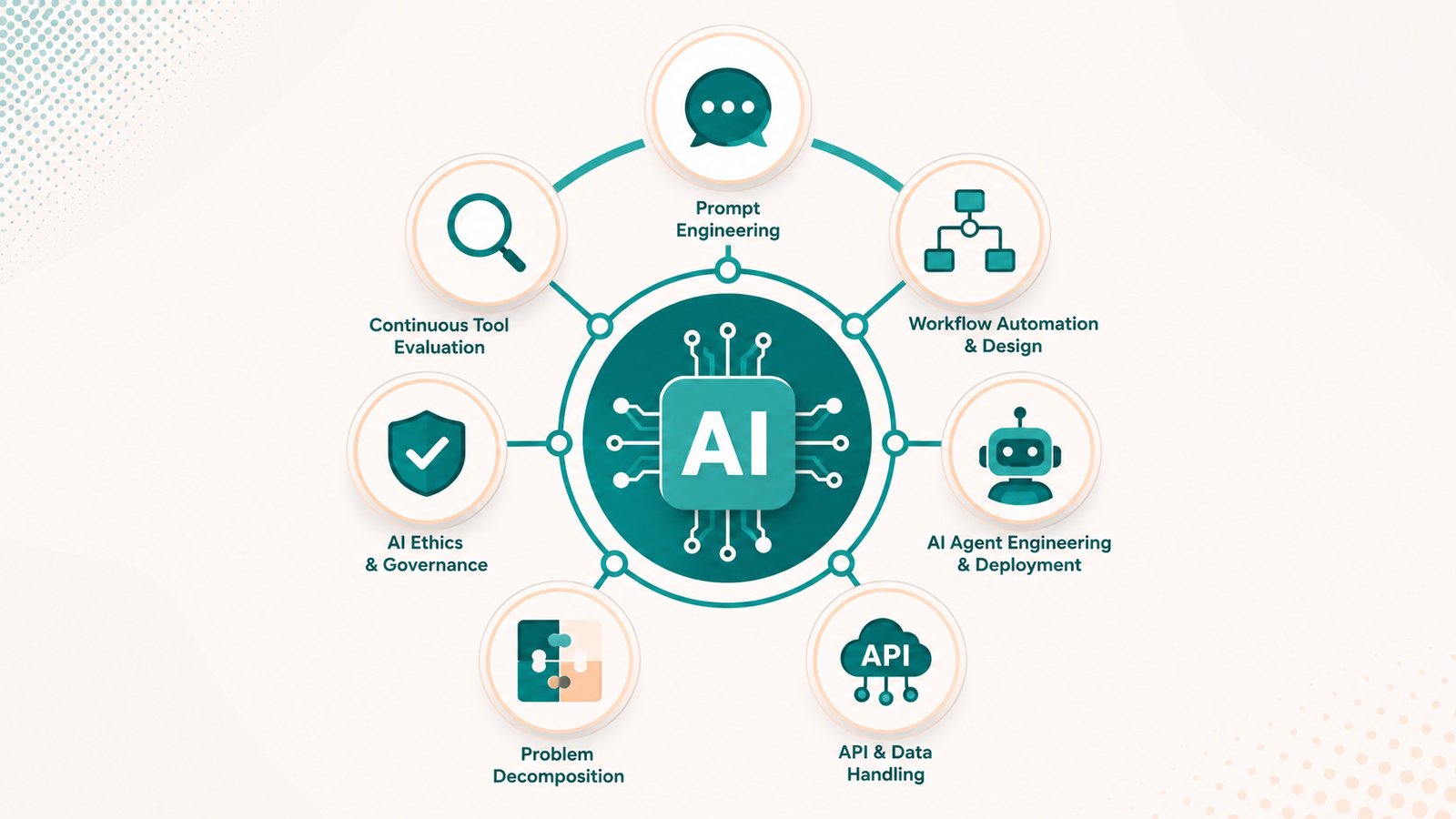
Prompt Engineering
Prompt engineering involves writing structured system and user prompts to guide artificial intelligence models (such as ChatGPT, Claude, or Gemini). The primary goal is to ensure models return reliable, clean, and properly formatted data (such as JSON) that other software programs can read and process seamlessly.
Workflow Automation & Design
Workflow automation relies on using visual no-code and low-code platforms (like Make, Zapier, or n8n) to link triggers, logic rules, and cloud applications together. This skill turns static processes into dynamic, self-executing digital pipelines.
AI Agent Engineering & Deployment
AI agent engineering focuses on setting up autonomous LLM (Large Language Model) systems. Unlike basic chatbots, these agentic systems can make decisions, utilize external software tools, and execute multi-step complex business goals without constant human input.
API and Data Handling
Understanding API integration and data passing is critical for scaling AI Automation systems. Professionals must understand how webhooks, REST APIs, and modern databases interact to transfer structured information securely and instantly between platforms.
2. Non-Technical & Strategic AI Skills
Technical know-how alone isn’t enough; strategic application defines long-term value.
Problem Decomposition: Breaking down complex business processes into actionable, automatable steps.
AI Ethics and Governance: Ensuring automated actions adhere to corporate policies, data privacy laws, and security standards.
Continuous Tool Evaluation: Auditing and selecting the most reliable AI tools and LLM integrations for specific operations.
3. Why AI Automation Skills Matter in 2026
The demand for professionals skilled in AI Automation spans across marketing, software engineering, customer success, and operations. Organizations prioritize individuals who do not simply use tools, but instead design automated systems that eliminate repetitive tasks, optimize resources, and reduce operational drag.
Skills in AI and AI Automation encompass both technical and strategic competencies needed to design, build, and deploy intelligent automated systems. They include prompt engineering, low-code workflow automation, autonomous AI agent creation, API/data handling, and machine learning fundamentals.
No, coding is not strictly mandatory for beginner to intermediate levels. Many modern platforms leverage no-code and low-code visual drag-and-drop builders. However, having basic knowledge of JavaScript, Python, or JSON payload structures significantly expands your customization options.
Prompt engineering is the craft of designing structured, high-context instructions for language models. It is critical because raw AI models require clear constraints, formatting guidelines, and context to deliver accurate, reproducible outputs for downstream software execution.
Regular chatbots simply respond to user prompts in a single conversational thread. Autonomous AI agents, however, are equipped with decision-making logic, memory, and tool integration capabilities—allowing them to execute multi-step workflows across external apps independently.
The most popular visual automation platforms include Make (formerly Integromat), Zapier, n8n, and Microsoft Power Automate. These tools allow users to visually connect APIs, triggers, and AI models into structured operational pipelines.
APIs (Application Programming Interfaces) act as digital bridges between software systems. In AI Automation, APIs allow an artificial intelligence model to pull real-time data from databases, trigger actions in CRMs, and send formatted responses back to business platforms.
Beginners should start by mastering prompt structures on platforms like ChatGPT or Claude, learning the basics of JSON data structures, and practicing visual integration workflows on platforms like Make or Zapier.
Customer service, marketing operations, sales lead qualification, IT service desks, and financial data processing benefit instantly from intelligent automation workflows by eliminating tedious manual data entry and response loops.
Classic automation relies strictly on fixed, rule-based "if-this-then-that" triggers. AI Automation integrates artificial intelligence and machine learning, enabling the system to process unstructured data (like raw emails or documents), make context-aware decisions, and handle complex variable outputs.
Rather than replacing roles entirely, AI Automation shifts job requirements. Professionals who master these skills transition from executing manual, repetitive tasks to supervising, designing, and managing intelligent automated workflows, making them significantly more valuable in modern organizations.
What You Will Master.
- AI Fundamentals & Prompt Engineering
- Automation Tools & No-Code Systems
- AI for Business & Marketing
- Real-World Project Building
- Freelancing & Career Strategy
Apply for Learning
AI Program