
What Is AI Automation? A Complete Guide for Beginners
What Is AI Automation? A Complete Guide for Beginners
What Is AI Automation? A Complete Guide for Beginners
What Is AI Automation? A Complete Guide for Beginners, Meaning, Benefits & Examples
Every business today is looking for ways to work faster, cut costs, and reduce manual errors. That is exactly where AI automation comes in. It is one of the biggest technology shifts happening right now, and understanding it can help you make smarter decisions for your business, career, or content strategy.
In this guide, you will learn what AI automation actually means, how it works, why it matters in 2026, and where it is already being used successfully.
What Is AI Automation?
AI automation uses machine learning, natural language processing, and other intelligent technologies to handle routine tasks and streamline workflows. In simple words, it is the combination of two powerful ideas: automation and artificial intelligence.
Traditional automation follows fixed, rule-based steps. It does the same thing every time, no matter what changes. AI automation is different. It can understand messy or unstructured input, make decisions on its own, adapt to new situations, and even improve over time as it learns from more data.
Think of it this way: automation moves a task along a track, while AI adds the ability to think, adjust, and respond intelligently along that track.
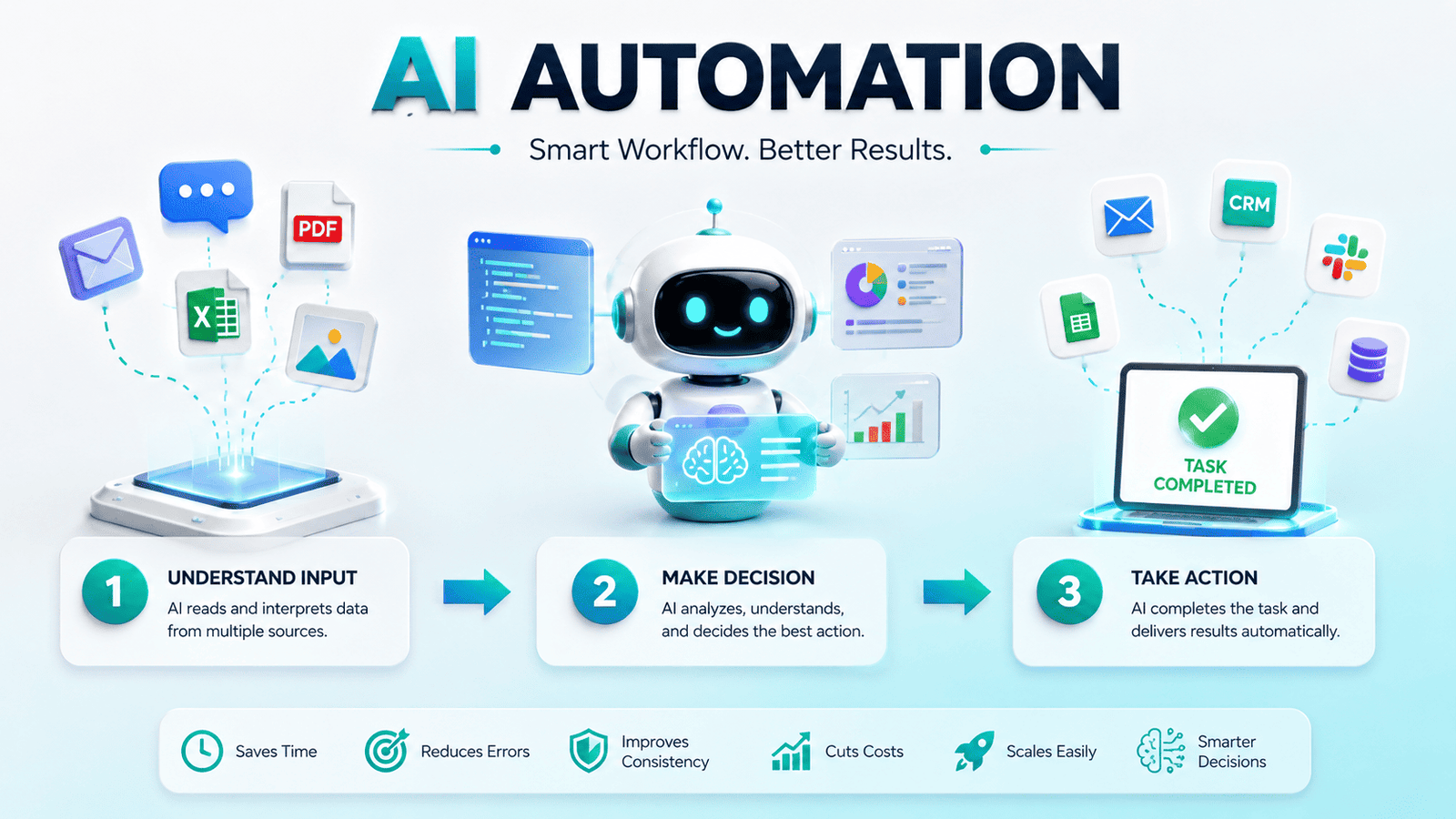
How AI Automation Works
AI automation generally works in three simple stages:
1. Understanding the input – The system uses machine learning and natural language processing to read and interpret data, whether it is a customer message, an email, an image, or a document.
2. Making a decision – Based on the data, the AI applies logic, scores urgency, classifies information, or predicts the next best action.
3. Taking action – The system then completes the task automatically, such as sending a reply, updating a record, routing a request, or generating content, often without any human involvement.
For example, when a new customer support ticket arrives, an AI automation system can understand the issue, judge how urgent it is, and route it to the right team member in seconds. What used to take hours of manual sorting now happens almost instantly.
Why AI Automation Matters Right Now
AI automation is no longer an experimental idea. It has become a core priority for businesses across industries. Adoption has grown massively over the past few years, and most organizations today already use AI in at least one part of their operations, from customer service to marketing to finance.
This growth is happening because AI automation solves real, everyday problems: too many repetitive tasks, slow response times, inconsistent quality, and rising operational costs.
Key Benefits of AI Automation
1. Saves Time and Increases Productivity Tasks that once took hours, like sorting emails, processing invoices, or writing first drafts of content, can now be completed in minutes. Teams can then focus their energy on strategic, high-value work instead of repetitive chores.
2. Reduces Human Error Manual work is prone to mistakes, especially when done repeatedly under time pressure. AI automation applies the same logic consistently every time, which significantly reduces errors in areas like data entry, compliance, and reporting.
3. Improves Consistency With AI automation, the outcome does not depend on which employee handled the task or how tired they were that day. The system follows the same approved process every single time, which builds more reliable results across teams and shifts.
4. Cuts Operational Costs By reducing manual labor on routine tasks, businesses save significantly on operational costs while still maintaining, or even improving, output quality.
5. Enables Better and Faster Decisions AI automation can analyze large amounts of data quickly and highlight patterns that humans might miss, helping businesses make informed decisions faster than traditional methods allow.
6. Scales Easily During busy periods or sudden demand spikes, AI-powered systems can handle increased workloads without needing to hire and train extra staff immediately.
Real-World Examples of AI Automation
AI automation is already active across many industries:
- Customer Service: Chatbots and AI agents understand customer queries, resolve simple issues instantly, and escalate complex ones to human agents.
- Marketing and Content: AI helps draft blog posts, social media captions, and ad copy, cutting content production time while supporting SEO performance.
- E-commerce: Online stores use AI to show personalized product recommendations based on browsing history and buying behavior.
- Finance: AI automation flags unusual transactions, speeds up invoice processing, and supports fraud detection.
- Healthcare: AI systems assist with patient scheduling, documentation, and identifying patterns in medical data.
- Retail: Businesses use AI to forecast seasonal demand and manage inventory more efficiently, reducing waste.
AI Automation vs Traditional Automation
The biggest difference lies in flexibility. Traditional automation is rule-based; it only works exactly as programmed and struggles with anything unexpected. AI automation, on the other hand, can interpret unstructured data, adjust to new patterns, and continue learning and improving. This is why AI automation is considered the next stage of digital transformation rather than a simple replacement for old tools.
Getting Started With AI Automation
If you are considering AI automation for your business, start small. Identify one repetitive, time-consuming task, such as email sorting, lead follow-ups, or content drafting, and automate that first. Use no-code or low-code AI tools that are widely available today, measure the results, and gradually expand to other workflows once you see clear improvements. Avoid trying to automate everything at once, as poor planning can lead to system errors or inconsistent output.
Conclusion
AI automation is reshaping the way businesses and individuals work by combining the speed of automation with the intelligence of AI. It saves time, reduces errors, cuts costs, and helps teams focus on work that truly needs human judgment. Whether you run a small business, manage a content team, or are simply exploring new technology trends, understanding AI automation today can give you a real advantage tomorrow. The businesses that start adopting it thoughtfully now, one workflow at a time, will be the ones best positioned for long-term growth.
AI automation is the use of artificial intelligence technologies, like machine learning and natural language processing, to perform tasks automatically and make smart decisions without needing constant human input.
Regular automation follows fixed, pre-set rules and cannot adapt. AI automation can understand unstructured data, make decisions, and adjust its behavior as conditions change, making it far more flexible.
Customer service, marketing, e-commerce, finance, healthcare, and retail are among the industries seeing the biggest gains, using AI automation for tasks like support, personalization, fraud detection, and inventory management.
No. Many no-code and low-code AI automation tools are affordable and easy to use, making it possible for small businesses and even individual creators to automate tasks like customer replies, content creation, and lead follow-ups.
What You Will Master.
- AI Fundamentals & Prompt Engineering
- Automation Tools & No-Code Systems
- AI for Business & Marketing
- Real-World Project Building
- Freelancing & Career Strategy
Apply for Learning
AI Program