
The AI Race vs. AI Jobs
The AI Race vs. AI Jobs
The AI Race vs. AI Jobs
AI Jobs vs AI Race 2026: Real Data on Job Loss & Growth
The AI Race vs. AI Jobs: Reality Check (2026)
The AI Race between OpenAI, Google, Anthropic, and Microsoft has moved past a simple contest of “who builds the smartest model.” By 2026, the real battleground is agentic execution, low-latency reasoning, and enterprise cost-efficiency — meaning AI systems that can actually complete multi-step tasks on their own, respond instantly, and save companies real money.
This shift matters far beyond the tech industry itself. Every time a new model launches, headlines warn that “AI will take all our jobs.” But the real 2026 data tells a more nuanced story. It’s not a simple story of mass job loss — it’s a story of task-level substitution versus role professionalization. In plain English: AI is automating specific tasks inside jobs, not wiping out entire professions overnight. At the same time, it’s raising the bar for what human expertise looks like.
If you’re a working professional, a student, or a business owner trying to make sense of where things are actually headed, understanding what AI in automation really means for salaries and careers is now a practical necessity — not just a curiosity.
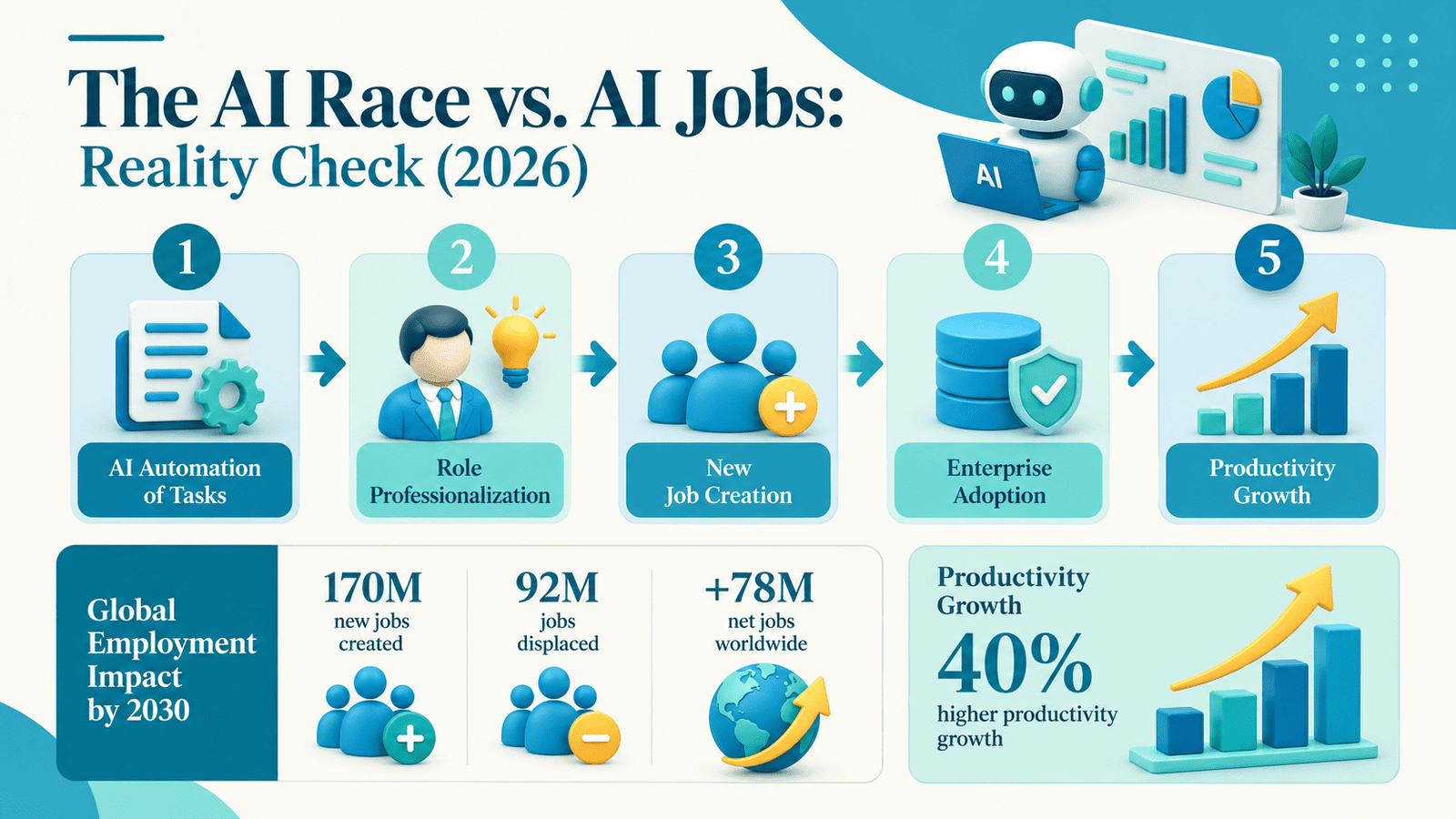
What the 2026 Data Actually Shows
Let’s go through the numbers that matter, one at a time, without the hype.
1. Net Employment Impact: +78 Million Jobs by 2030
According to the World Economic Forum’s Future of Jobs Report, the global economy is projected to see 170 million new jobs created and 92 million jobs displaced between now and 2030. That nets out to a positive gain of 78 million jobs worldwide.
This is an important number because it directly contradicts the “AI will end employment” narrative. The WEF’s own analysis describes this net increase as being driven by demand for AI and data specialists, big data analysts, and roles tied to digital infrastructure and the green transition. In other words, AI is creating new categories of work even as it removes older, repetitive ones.
2. Short-Term Disruption Is Real, But Localized
That doesn’t mean the transition is painless. Recent labor market analysis points to roughly 16,000 net U.S. jobs per month being affected by the ongoing gap between AI-driven substitution (AI doing the task instead of a human) and AI-driven augmentation (AI helping a human do the task faster). This is a much smaller number than the apocalyptic headlines suggest, but it’s concentrated in specific job categories — mostly clerical, data-entry, and repetitive administrative work.
3. Enterprise Adoption Has Crossed the Tipping Point
By Q1/Q2 2026, roughly 72% of enterprises report having generative or agentic AI systems in active production — not just pilot projects or experiments, but tools genuinely running business operations. This is the single biggest reason the job market is shifting so fast: companies aren’t testing AI anymore, they’re deploying it at scale for smart business automation.
4. Junior Roles Are Being “Professionalized,” Not Eliminated
Here’s the statistic that should worry — and motivate — anyone early in their career. According to the PwC AI Jobs Barometer 2026, junior roles exposed to AI now demand 7x more leadership and strategic thinking traits than they did before. AI is absorbing the routine, low-judgment parts of entry-level work, which means the humans still in those roles are expected to operate at a higher level almost immediately.
This is what analysts mean by “role professionalization” — AI isn’t necessarily cutting junior headcount everywhere, but it is compressing the learning curve and raising expectations. Employers now want junior employees who can supervise AI output, make judgment calls, and think strategically — not just execute repetitive tasks. Building these kinds of core AI and automation skills early is quickly becoming the difference between staying competitive and falling behind.
5. The Productivity Gap Is Widening
Companies with high AI exposure are seeing 40% higher productivity growth compared to companies with low AI exposure, per PwC’s 2026 findings. This gap has been tripling since 2022, and it’s now showing up in wages and headcount too — AI-exposed companies are growing both their workforce and their pay faster than companies that haven’t adopted AI meaningfully.
This is arguably the most important insight in the whole dataset: companies that adopt AI well aren’t shrinking — they’re growing faster and paying more. The risk isn’t AI itself. The risk is being at a company (or in a role) that refuses to adapt.
Task-Level Substitution vs. Role Professionalization: What This Means for You
Put simply:
Task-level substitution = AI takes over a specific, repeatable task (writing a first-draft email, scheduling, basic data entry, simple customer queries).
Role professionalization = The human role around that task evolves to require more judgment, oversight, creativity, and strategic decision-making.
Almost no job is being deleted wholesale. Instead, jobs are being redesigned in real time. The professionals who survive and thrive in this shift are the ones who move up the value chain — supervising AI systems, making decisions AI can’t make, and using automation to multiply their own output rather than compete with it.
This is exactly the shift explored in the broader conversation around future-proofing your career with AI — the goal isn’t to out-code AI, it’s to out-think it.
What Businesses and Professionals Should Actually Do in 2026
Businesses: Move from experimenting with AI to embedding it into core workflows — the 72% enterprise adoption number shows the window for “wait and see” has already closed.
Junior professionals: Focus on judgment-heavy skills — strategy, communication, leadership, and problem-solving — since these are exactly what AI-exposed junior roles now demand.
Everyone: Understand what AI automation actually is, beyond the buzzwords, so you can identify where it helps you rather than threatens you. This starts with a solid beginner’s guide to AI automation.
The AI Race is not slowing down — if anything, agentic execution and enterprise deployment are accelerating in the second half of 2026. But the job market data is clear: this is a redesign, not a demolition. The professionals and businesses paying attention to how roles are changing — not just whether jobs will disappear — are the ones positioning themselves to win.
Conclusion
The AI Race isn’t erasing jobs — it’s redesigning them. With 78 million net new roles projected by 2030 and AI-exposed companies growing faster and paying more, the real opportunity lies in adapting early. Professionals who build judgment-driven skills alongside AI fluency will lead this new labor market, not lose to it.
According to the World Economic Forum's Future of Jobs Report, yes — on net. The report projects 170 million new jobs created globally against 92 million displaced, resulting in a net gain of 78 million jobs by 2030. However, this net positive doesn't mean every individual worker is safe; it means the overall economy is expected to add more roles than it removes, with new demand concentrated in AI, data, and digital infrastructure roles.
Task-level substitution refers to AI taking over a specific, narrow task within a job — such as drafting routine emails, basic data entry, or answering simple customer queries — rather than replacing the entire job or profession. Most roles contain a mix of tasks, and AI is currently automating the most repetitive ones while leaving judgment-heavy tasks to humans.
Role professionalization describes how AI is reshaping existing jobs to demand more human expertise rather than less. As AI absorbs routine tasks, the remaining human responsibilities shift toward strategy, leadership, and complex decision-making. PwC's 2026 data shows junior AI-exposed roles now require 7x more leadership and strategic skills than before — a clear sign of professionalization in action.
Recent 2026 labor data points to roughly 16,000 net U.S. jobs per month being affected by the gap between AI substitution and augmentation. This is a relatively modest monthly figure compared to the scale of the overall U.S. labor market, and it's concentrated in specific categories like clerical and administrative work rather than spread evenly across all industries.
As of Q1/Q2 2026, industry reports indicate that roughly 72% of enterprises have generative or agentic AI systems actively running in production environments — not just pilot testing. This marks a major shift from earlier years when most AI adoption was experimental rather than operational.
Junior roles are more exposed to task automation since they often involve repetitive, entry-level tasks. However, rather than being eliminated outright, PwC's 2026 AI Jobs Barometer shows these roles are being "professionalized" — meaning employers now expect junior employees to demonstrate significantly more leadership and strategic thinking than before, essentially compressing the traditional career ladder. Building strong AI and automation skills early is one of the best ways to stay ahead of this shift.
Yes. PwC's 2026 data shows companies most exposed to AI have 40% higher productivity growth compared to companies least exposed to AI, and this gap has been widening since 2022. These AI-forward companies are also increasing headcount and wages faster than their less AI-exposed counterparts, suggesting the productivity gains are being shared with employees rather than only benefiting shareholders.
No, this narrative oversimplifies what's actually happening. The 2026 data shows a more nuanced reality: AI is automating specific tasks within jobs while simultaneously creating new categories of work and raising skill requirements in existing roles. It's a redistribution and redesign of work, not a wholesale elimination of employment.
The World Economic Forum's research points to AI and machine learning specialists, big data analysts, information security analysts, and roles tied to digital infrastructure and sustainability as among the fastest-growing categories. These roles are directly tied to building, maintaining, and securing the AI systems companies are now deploying at scale.
Based on the professionalization trend, the most valuable skills are judgment, leadership, strategic thinking, and the ability to oversee or direct AI systems rather than compete with them on repetitive tasks. This shift is central to why learning AI automation skills is becoming essential for career security in 2026 and beyond.
Not quite. While tech layoffs have made headlines, the underlying labor data suggests something different is happening — a structural redesign of roles around AI capability rather than a simple contraction of the workforce. This distinction is explored in more depth in the discussion of what comes after the layoff headlines.
Businesses that are seeing the strongest results are moving AI from experimentation into core operational workflows — automating routine processes while reallocating human talent toward judgment-heavy, high-value work. This is the same approach behind transforming business operations with smart automation tools, which is increasingly becoming standard practice rather than a competitive edge.
What You Will Master.
- AI Fundamentals & Prompt Engineering
- Automation Tools & No-Code Systems
- AI for Business & Marketing
- Real-World Project Building
- Freelancing & Career Strategy
Apply for Learning
AI Program