
PadCare Labs Case Study: How Green Innovation & Smart Automation Disrupt Sanitation Tech
PadCare Labs Case Study: How Green Innovation & Smart Automation Disrupt Sanitation Tech
PadCare Labs Case Study: How Green Innovation & Smart Automation Disrupt Sanitation Tech
PadCare Labs Case Study: Revolutionizing Menstrual Waste Management Through Green Tech and Smart Automation
Managing menstrual waste has remained one of the most overlooked ecological and sanitary challenges across the globe. Millions of non-biodegradable sanitary napkins end up in landfills or open incinerators every day, generating toxic emissions and severe environmental hazards.
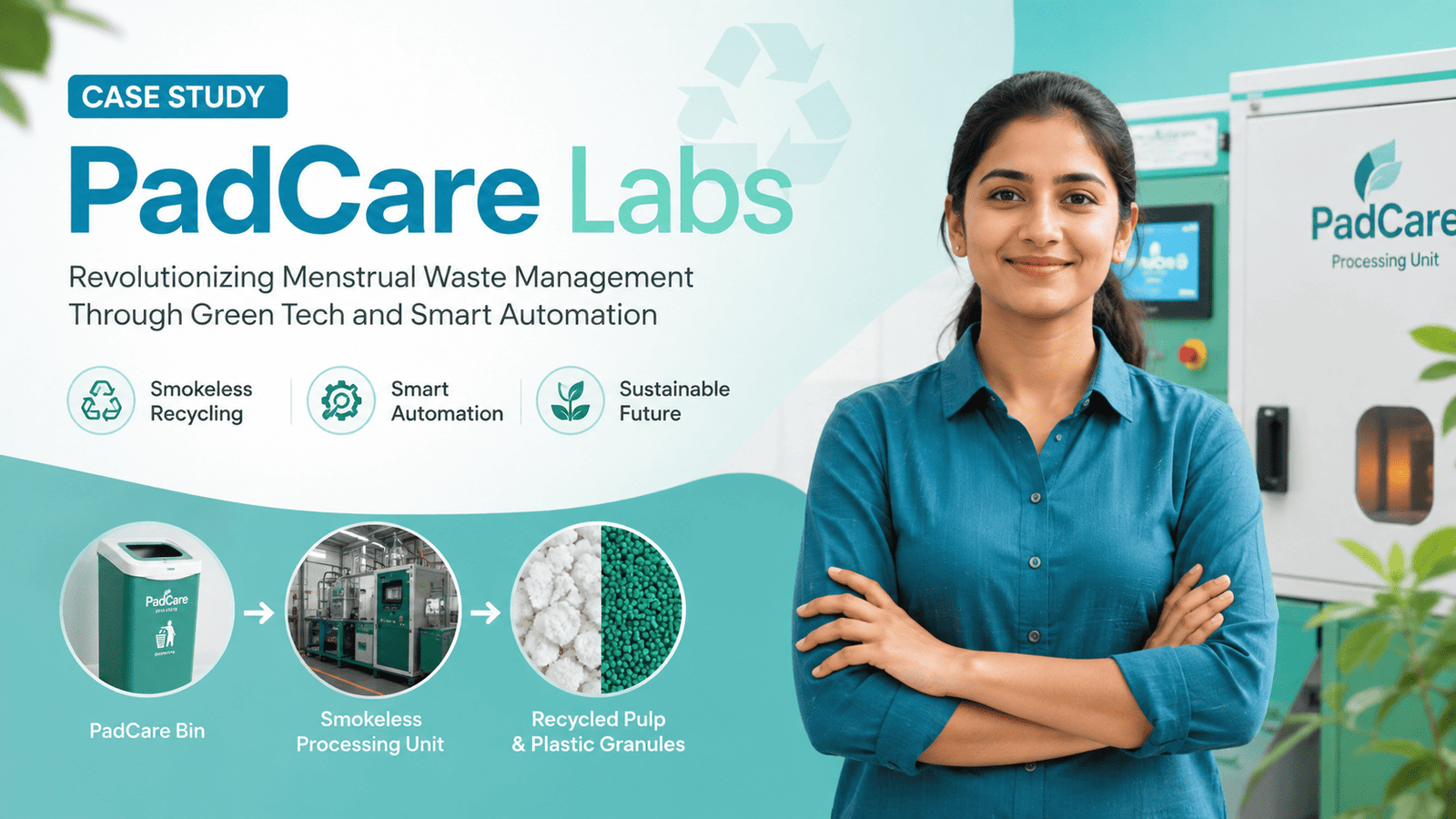
PadCare Labs, a pioneering Indian sanitation-tech startup founded by Ajinkya Dhariya, has engineered a breakthrough solution to this crisis. By developing the world’s first smokeless, patented chemical-mechanical recycling system, PadCare Labs converts hazardous menstrual waste into high-grade recycled plastic pellets and sterile paper pulp—achieving an extraordinary material recovery rate of over 98%.
The Problem: The Environmental & Human Cost of Sanitary Waste
Traditional disposal methods for sanitary napkins rely heavily on open dumping or high-temperature incineration. These methods present critical challenges:
Severe Environmental Toxicity: Burning pads releases harmful dioxins, furans, and greenhouse gases into the atmosphere.
Landfill Congestion: Standard pads contain up to 90% plastic components that take over 500 years to decompose naturally.
Health Risks for Sanitation Workers: Manual segregation exposes workers to infectious pathogens and biological hazards without adequate protection.
The Innovation: How PadCare’s Smokeless Recycling Technology Works
PadCare Labs redesigned the entire sanitary disposal lifecycle by introducing automated source collection alongside centralized mechanical-chemical processing.
PadCare Bin (Smart Collection): Installed directly inside female washrooms, these automated, touchless collection bins use special multi-barrier liners to store soiled napkins odor-free and pathogen-free for up to 30 days.
PadCare Processing Unit (Central Disinfection & Segregation): Collected pads undergo a multi-step chemical-mechanical breakdown without any combustion or smoke generation.
Material Recovery & Upcycling: The process breaks the product down into sterilized cellulose pulp (used for packaging, paper products, and planter pots) and high-quality plastic granules (used for industrial manufacturing).
Modern cleantech ventures like PadCare are proving that Transforming Business with Smart Automation is essential for scaling circular economy operations efficiently.
How Advanced Tech and Automation Drive CleanTech Scale
To scale localized green hardware into a nationwide logistics network, modern cleantech enterprises depend on operational automation, route optimization algorithms, and sensor-driven hardware monitoring. Understanding What Is AI Automation? A Complete Guide for Beginners reveals how hardware-meets-software systems automate supply chain pickups, monitor bin capacities remotely, and track environmental impact metrics for B2B enterprises.
Moreover, as industry workflows modernize, AI is evolving in layers — from rule-based systems to fully autonomous AI agents, enabling green enterprises to automate inventory forecasting, optimize multi-city logistics routes, and manage carbon credit reporting without manual administrative strain.
Conclusion:
PadCare Labs demonstrates how targeted engineering and sustainable thinking can transform an urgent ecological crisis into a circular business opportunity. By pairing mechanical innovation with automated resource tracking, the startup establishes a scalable blueprint for global waste management and sustainable urban sanitation.PadCare Labs is an Indian sanitation-technology startup founded by Ajinkya Dhariya that provides smokeless, patented recycling solutions for sanitary pads.
It uses a patented chemical-mechanical process that breaks down soiled napkins into sterilized paper pulp and reusable plastic granules without burning them.
PadCare achieves over a 98% material recovery rate from collected sanitary waste.
The recovered cellulose paper pulp is used for packaging materials and paper goods, while the recycled plastic is repurposed into consumer goods, paver blocks, and plant pots.
PadCare Bins are automated, contactless disposal units that seal sanitary waste in multi-layered, antimicrobial liners to prevent odor and bacterial growth for up to 30 days.
Conventional incinerators release toxic fumes, dioxins, and greenhouse gases because sanitary pads contain high percentages of plastic polymers.
CleanTech enterprises use automation for real-time sensor tracking in disposal units, optimized waste collection logistics, and automated sustainability compliance reporting. Exploring What is AI in Automation? Types, Salary & Career Guide 2026 highlights how automation professionals architect these smart industrial frameworks.
Yes, PadCare uses a closed-loop chemical-mechanical system that operates without any combustion, producing zero smoke or harmful toxic emissions.
PadCare partners with corporate tech parks, educational campuses, hospitals, airports, and industrial offices seeking zero-waste menstrual hygiene solutions.
Engineers building sustainable infrastructure rely on smart sensor diagnostics and predictive modeling. Gaining deep domain expertise through What Are Skills in AI and AI Automation? (2026 Core Skills Guide) helps professionals design high-efficiency, data-driven recycling supply chains.
What You Will Master.
- AI Fundamentals & Prompt Engineering
- Automation Tools & No-Code Systems
- AI for Business & Marketing
- Real-World Project Building
- Freelancing & Career Strategy
Apply for Learning
AI Program