
Top AI Skills in 2026: What You Actually Need to Learn to Stay Ahead
Top AI Skills in 2026: What You Actually Need to Learn to Stay Ahead
Top AI Skills in 2026: What You Actually Need to Learn to Stay Ahead
Top AI Skills in 2026: Technical & Non-Technical Guide.
If you’ve been scrolling through job listings or LinkedIn lately, you’ve probably noticed something: “AI skills” is everywhere now. But here’s the confusing part — nobody really explains which AI skills matter. Is it coding? Prompting? Something else entirely?
The truth is, the top AI skills in 2026 fall into two clear buckets: technical capabilities for building AI systems and non-technical literacy for using AI productively. Which one you need depends entirely on your career path. A marketing manager doesn’t need the same skills as a machine learning engineer, and trying to learn everything at once is a recipe for burnout.
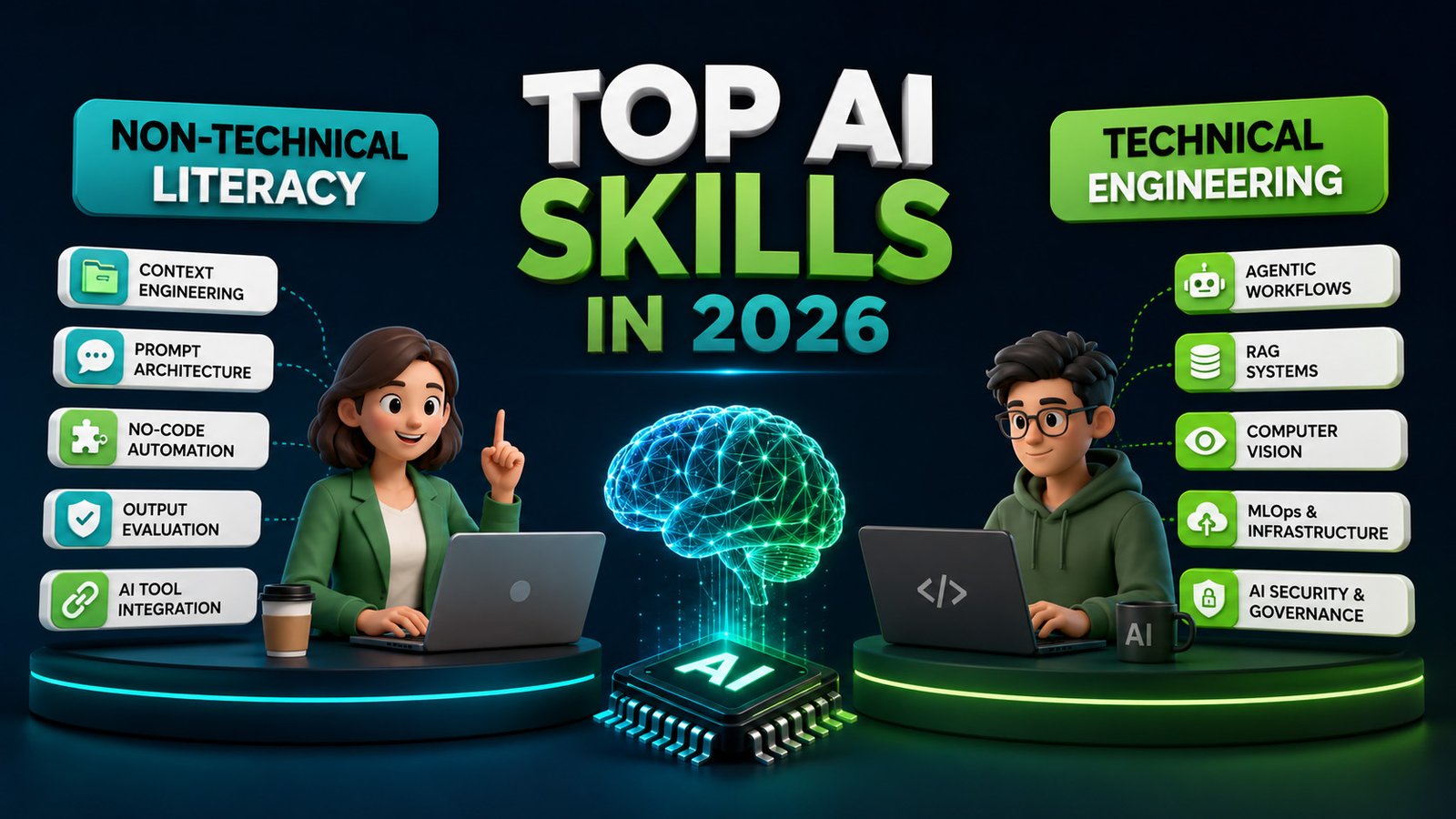
Technical & Non-Technical Guide
Learn. Earn. Grow. Top AI Skills
Follow for Helping People.
Use AI for Growth.
Non-Technical AI Literacy (For Everyday Professionals)
These skills are about working with AI tools efficiently, not building them. If you’re in business, marketing, operations, or management, this is your lane.
Context Engineering Instead of chatting with AI like a stranger, you feed it your actual business data — past reports, brand guidelines, customer info — so it responds like an informed team member instead of a generic chatbot. Think of it as onboarding an AI intern with the right files, not just a job title.
Prompt Architecture This goes beyond typing a one-off question. It’s about building reusable prompt templates with clear structure and constraints, so you get consistent, reliable outputs every time instead of gambling on random results.
No-Code Automation Connecting AI models to your everyday business apps — think Zapier-style workflows — so tasks like lead follow-ups, report generation, or customer replies happen automatically, without writing a single line of code.
Output Evaluation AI tools sound confident even when they’re wrong. This skill is about training yourself to critically check AI outputs and catch hallucinations before they end up in a client email or a business decision.
AI Tool Integration Combining standalone AI tools (like Notion AI) with your existing CRM or workflow software, so AI isn’t a separate app you visit — it’s woven into how your team already works.
Technical AI Engineering (For Builders and Developers)
These skills focus on actually building, training, and maintaining AI systems. This is the deeper, hands-on side.
Agentic Workflows Engineering multi-agent systems that can independently carry out complete, multi-step business goals — not just answer a question, but plan and execute a whole task from start to finish.
Retrieval-Augmented Generation (RAG) Building systems that ground AI responses in your company’s actual, private knowledge base, so the AI answers using real internal data instead of guessing from general training data.
Computer Vision Training models for object detection, image segmentation, and classification — the tech behind everything from quality inspection to image-based diffusion models.
MLOps & Infrastructure Setting up the training environments and deployment pipelines that get AI models running reliably on cloud platforms, at scale.
AI Security & Governance Implementing guardrails, reducing data bias, and securing applications against prompt injection attacks — an increasingly critical skill as more businesses put AI into production.
Which Path Should You Choose?
If you run a business, manage a team, or work in sales, marketing, or operations — start with the non-technical literacy skills. They’ll give you an immediate productivity edge without needing to learn to code.
If you’re a developer or planning a technical career shift, the engineering skills are where the long-term value (and salary growth) lies.
At AI Automation, we help businesses in Jaipur and beyond bridge exactly this gap — whether it’s building no-code automation workflows, setting up AI-powered chatbots for your website, or training your team on practical AI tools that actually move the needle. You don’t need to master everything on this list. You need the right skills for where you’re headed.
Want help figuring out your AI roadmap? Get in touch with AI Automation and let’s build a plan that fits your business.
The top AI skills in 2026 split into two categories: non-technical AI literacy (like prompt architecture, context engineering, and no-code automation) for everyday professionals, and technical AI engineering (like agentic workflows, RAG, and MLOps) for developers and technical roles. The right skills for you depend on your career path — business professionals benefit most from literacy skills, while those in tech should focus on engineering capabilities.
No. A large part of in-demand AI skills today are non-technical. Skills like context engineering, prompt architecture, output evaluation, and no-code automation let you use AI tools effectively without writing a single line of code. Tools like Zapier make it possible to connect AI models to your business apps through simple, visual workflows instead of programming.
Context engineering means feeding an AI model your actual business data — internal documents, brand guidelines, past reports, or customer information — instead of relying on generic prompts. This helps the AI respond with relevant, accurate, business-specific answers rather than generic responses that could apply to anyone.
Prompt architecture is the practice of building structured, reusable prompt templates with clear instructions and constraints, rather than typing random one-off questions. This matters because it makes AI outputs consistent and predictable, which is essential when you're using AI for repeated business tasks like content creation, customer support, or reporting.
RAG is a technical approach where an AI system pulls information from a specific, trusted knowledge base — like your company's internal documents — before generating a response. This grounds the AI's answers in real, verified data instead of letting it rely purely on general training knowledge, which significantly reduces inaccurate or made-up answers.
Agentic workflows involve building multi-agent AI systems that can independently complete entire multi-step tasks — not just answer a single question. For example, an agentic system might research a topic, draft content, check it for accuracy, and publish it, all without a human manually managing each step.
AI models can sound confident even when they're factually wrong — this is known as hallucination. Output evaluation is the skill of critically reviewing AI-generated content before using it, so you catch errors, inaccuracies, or irrelevant information before they reach a client, customer, or business decision.
MLOps (Machine Learning Operations) refers to setting up the infrastructure needed to train, deploy, and maintain AI models at scale, typically on cloud platforms. This is a technical skill best suited for developers, data engineers, or IT teams responsible for running AI systems in production environments.
Very important, and increasingly non-negotiable for businesses. AI security and governance covers building guardrails, minimizing data bias, and protecting applications from prompt injection attacks. As more companies put AI-powered tools into live production — like chatbots or automated workflows — securing these systems against misuse becomes a critical responsibility.
For most small business owners, starting with non-technical AI literacy makes more sense. Skills like no-code automation, prompt architecture, and AI tool integration deliver immediate productivity gains without needing a technical background. Once your business scales and you need custom AI systems — like a trained chatbot or an automated workflow — that's when partnering with an AI automation expert or building technical capability becomes valuable.
What You Will Master.
- AI Fundamentals & Prompt Engineering
- Automation Tools & No-Code Systems
- AI for Business & Marketing
- Real-World Project Building
- Freelancing & Career Strategy
Apply for Learning
AI Program