Real AI Governance Explained: Beyond Data Rules
Real AI Governance Explained: Beyond Data Rules
Real AI Governance Explained: Beyond Data Rules
AI Governance vs Data Governance: What Most Companies Get Wrong
Most companies believe they have AI governance in place.
They don’t.
What they actually have is data governance with the word “AI” pasted on top of it.
If you ask any team about their AI policies, you’ll hear the same five words over and over: data quality, access control, audit logs, security, and compliance. These are important. Nobody is saying they aren’t. But they don’t answer the questions that actually matter when AI is involved.
The Questions Data Governance Can’t Answer
Data governance was built for a world where systems followed fixed rules. You told the software what to do, and it did exactly that. Nothing more.
AI doesn’t work that way. AI systems learn, adapt, and sometimes act on their own. That’s why data governance rules alone leave huge gaps. Here are three questions most companies still can’t answer:
1. Can this model still be trusted after deployment? A model that worked perfectly on day one can quietly get worse over time. Data changes. Real-world patterns shift. Without ongoing monitoring, nobody notices until something breaks.
2. What happens when an AI agent takes action on its own? Modern AI agents don’t just answer questions. They can send emails, update records, make purchases, or trigger workflows without a human clicking “approve” every time. What controls stop it from going too far?
3. Who is accountable when AI makes the wrong decision? If an AI model denies a loan, misdiagnoses a case, or takes a harmful automated action, someone has to own that outcome. Data governance never had to answer this question, because traditional software didn’t make judgment calls.
This is the real gap. Real AI governance goes beyond data. It has to cover the entire lifecycle of how AI thinks, acts, and is held accountable.
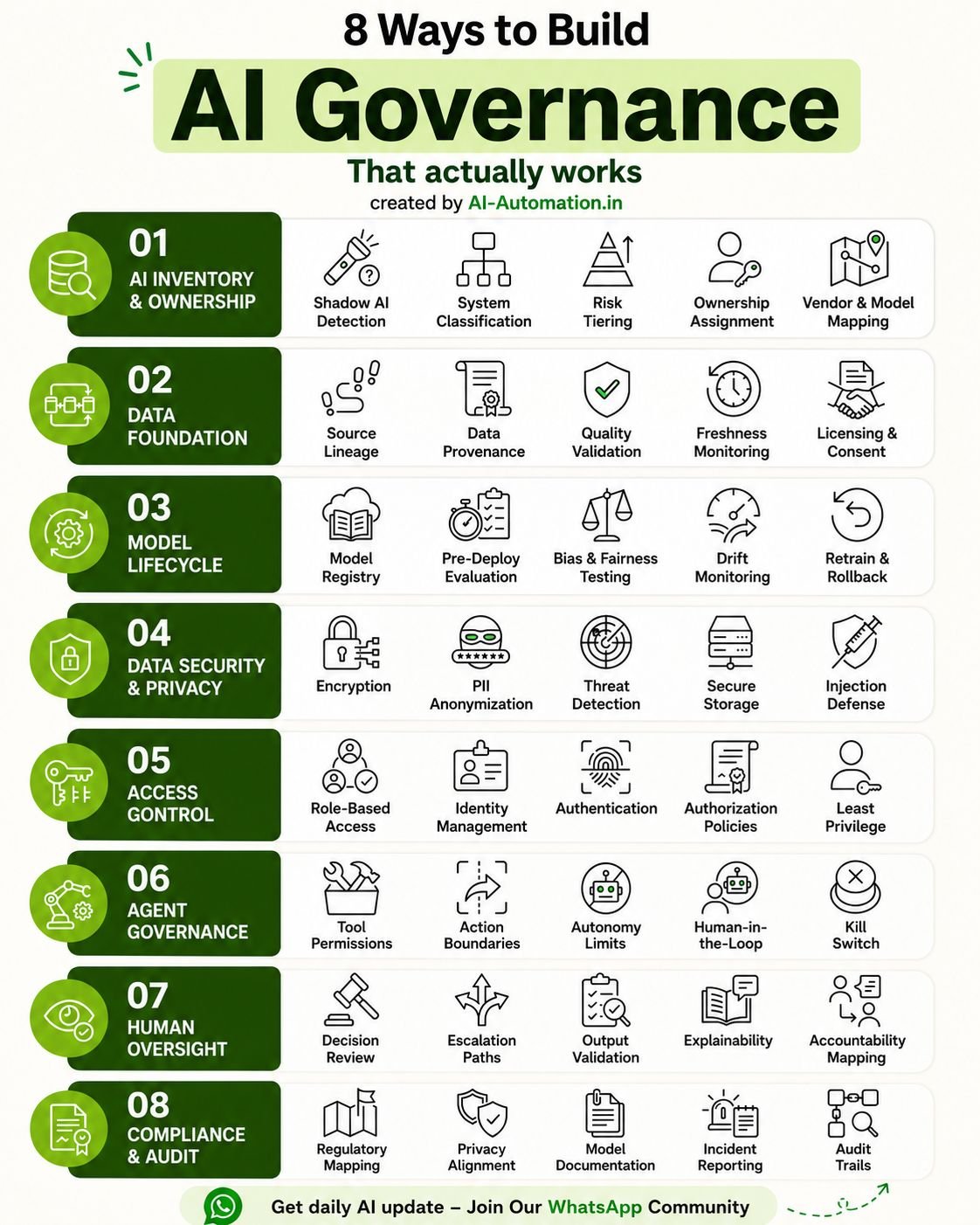
The 8 Pillars of Real AI Governance
Here’s what a genuine AI governance framework should include:
1. AI Inventory & Ownership
You can’t govern what you don’t know exists. Every AI system in your company needs to be listed, tracked, and assigned to a clear owner. No AI tool should be running without someone accountable for it.
2. Data Foundation
This is where data governance still matters, just not as the whole story. Clean, accurate, and compliant data is the base layer every AI model depends on. Bad data means unreliable AI, no matter how advanced the model is.
3. Model Lifecycle Management
AI isn’t a “set it and forget it” tool. Performance needs to be monitored continuously. When a model starts drifting or producing weaker results, it needs to be retrained or rolled back to a safer version.
4. AI Security & Privacy
AI systems face threats that traditional software doesn’t. Both the data feeding the model and the model itself need protection from attacks, manipulation, and misuse.
5. Access & Permission Control
This defines exactly who, and what, is allowed to interact with your AI systems. This includes both human users and other automated systems or agents.
6. Agent Governance
As AI agents take on more autonomous tasks, they need clear boundaries: tool permissions, action limits, required approvals for sensitive tasks, and a working kill switch when something goes wrong.
7. Human Oversight
AI can assist, suggest, and automate. But humans remain accountable for outcomes. Oversight isn’t optional; it’s the safety net that keeps AI decisions in check.
8. Compliance & Auditability
Every AI decision should be traceable and explainable. If a regulator, customer, or internal team asks “why did the AI do this?”, you need a clear answer, not a shrug.
Why This Shift Matters Now
The biggest change happening in technology right now isn’t the move from traditional software to AI software.
It’s the move from predictable systems to systems that reason, learn, and act on their own.
Old software did exactly what it was told, every single time. AI systems interpret situations, make judgment calls, and sometimes take independent action. That fundamental difference means they need a fundamentally different governance approach.
If your company is only governing the data going into your AI systems, you’re missing the AI itself: how it behaves, how it’s monitored, and who is responsible when it acts.
Conclusion
AI governance and data governance are not the same thing, even though many companies still treat them as one. Data governance protects the information going into your systems. AI governance protects everything the AI does with that information, including its decisions, its actions, and its long-term reliability.
As AI agents become more capable of acting independently, the companies that build real AI governance frameworks, covering ownership, lifecycle management, security, agent boundaries, human oversight, and accountability, will be the ones that scale AI safely. The ones that don’t will keep discovering gaps the hard way, usually after something has already gone wrong.
If you’re only governing your data, you’re not governing your AI. It’s time to close that gap.
Data governance focuses on managing data quality, access, and security. AI governance covers the entire AI system: how models behave after deployment, how autonomous agents take action, and who is accountable for AI-driven decisions. Data governance is just one part of a complete AI governance framework.
AI agents can take real actions on their own, like sending messages, updating systems, or making purchases, without a human approving every step. Agent governance sets limits on what agents can do, requires approvals for sensitive actions, and includes a kill switch to stop an agent immediately if something goes wrong.
Accountability should always sit with a human owner, not the AI system itself. This is why AI Inventory & Ownership and Human Oversight are core parts of AI governance. Every AI system needs a named owner, and every automated decision needs a human who can review, explain, or reverse it.
Yes. Data governance is the foundation that AI governance is built on. Clean, accurate, and compliant data is still essential. The problem isn't that data governance is wrong, it's that it's incomplete on its own. Real AI governance includes data governance plus model monitoring, agent controls, security, and accountability.
What You Will Master.
- AI Fundamentals & Prompt Engineering
- Automation Tools & No-Code Systems
- AI for Business & Marketing
- Real-World Project Building
- Freelancing & Career Strategy
Apply for Learning
AI Program