Free AI Courses with Certificates 2026: IBM & Microsoft
Free AI Courses with Certificates 2026: IBM & Microsoft
Free AI Courses with Certificates 2026: IBM & Microsoft
Free AI Courses with Certificates in 2026: IBM SkillsBuild and Microsoft Learn Guide
AI skills are now useful in almost every job, from marketing and sales to coding and business automation. The good news is that you do not need to spend money to start. Platforms like IBM SkillsBuild and Microsoft Learn offer free AI courses that teach real concepts, and some give you badges or credentials you can share online.
But there is a catch. “Free” does not mean the same thing on every platform. Some courses are free to learn but charge for exams. Others give a badge, not a formal certification. In this guide, we explain what is truly free, what you will learn, and the best order to follow if your goal is AI automation. (Details last checked in October 2026.)
Quick Answer: Which Free AI Courses Are Worth Taking?
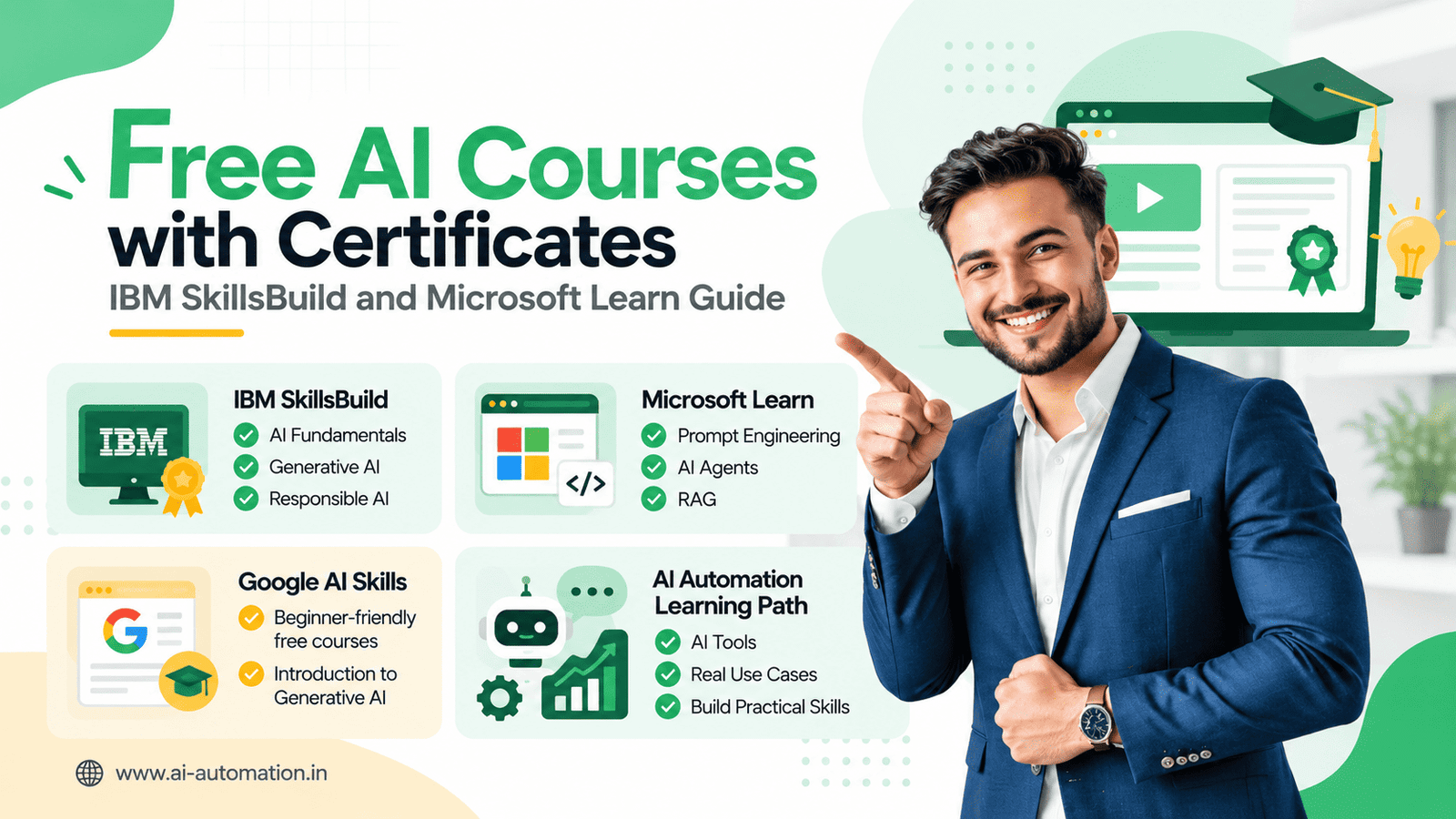
Start with IBM SkillsBuild for AI basics and AI ethics. Then use Microsoft Learn for prompt engineering, generative AI, AI agents, and RAG. Both platforms let you learn at no cost. IBM offers shareable digital credentials, while Microsoft Learn gives achievements and badges on your profile. Formal Microsoft certification exams may cost money unless you receive a voucher.
Why Learn AI for Free in 2026?
AI is changing how businesses handle customer support, marketing, data work, and daily tasks. Employers now look for people who understand AI tools, prompts, and basic automation ideas. Free courses help you build this base without any financial risk.
They also help you decide what to study next. After a few short modules, you will know whether you enjoy prompt writing, chatbots, data work, or building automated workflows. For freelancers and agency owners, this knowledge also helps you explain to clients what AI can and cannot do. It also makes search-friendly content, smarter customer support, and faster internal work much easier to plan.
Free AI Courses on IBM SkillsBuild
IBM describes SkillsBuild as a free learning program with more than 1,000 online courses and shareable digital credentials for completed learning. Topics include AI, cybersecurity, data analytics, and cloud computing. The courses suit both beginners and advanced learners.
For AI learners, the most useful starting points are:
- AI Fundamentals: Covers AI concepts, machine learning basics, chatbots, neural networks, and AI ethics.
- Generative AI and prompt writing: Helps you learn how to work with generative AI tools.
- Responsible AI: Explains fairness, trust, and safe use of AI.
IBM has described its AI fundamentals plan as about six courses and roughly 10 hours of study. Note that credential availability can depend on your learning plan and registration type, so read the badge requirements before you begin.
Free AI Courses on Microsoft Learn
Microsoft states that Microsoft Learn training is free for anyone interested. When you finish a module and pass a short knowledge check, you earn an achievement or badge on your Learn profile. Useful AI topics you can find there include:
- Get started with AI and introduction to AI concepts
- Generative AI and AI agents
- Prompt engineering and GitHub Copilot
- Retrieval-Augmented Generation (RAG)
- AI concepts for developers
Many modules include free sandboxes, so you can practise without a paid account. Module names, lengths, and availability change from time to time, so search the AI catalog to see the latest versions. Many modules are short, which makes them easy to finish after work.
Is Google AI Essentials Free?
Not completely. Google AI Essentials is offered through Coursera as a subscription. Google lists $49 USD per month after a 7-day trial in some countries and says the price may be lower elsewhere, so check the Coursera page for your local price.
Google does offer free options too. Its India AI skills page lists beginner-friendly free courses, such as Introduction to Generative AI, and a short Gemini workshop that gives a certificate on completion. If your budget is zero, start with these free options and decide later whether the paid course is worth it.
Who Should Take These Free AI Courses?
These courses are useful for many types of learners. Students can build a strong base before their first job. Working professionals can learn how AI tools fit into daily tasks like writing, reporting, and research. Freelancers can add AI services to their offer list. Small business owners can understand where chatbots and automation may save time.
You do not need a technical background for the basic courses. If you can follow instructions on a screen and spend a little time each day, you can begin. The only thing you need is a clear goal, such as “I want to understand AI,” “I want to write better prompts,” or “I want to build a chatbot.”
Free Learning vs Certificate: What Do You Really Get?
Many learners mix up these three things:
- Badge or achievement: Proof that you completed a module or learning plan.
- Digital credential: A shareable, verifiable record of completed learning, such as IBM’s credentials.
- Formal certification: An exam-based credential from the company, which usually costs money.
A free badge shows that you finished the learning. It does not replace a job-ready certification, so pair it with small projects. This approach is honest, and clients and employers trust it more.
Best Order to Learn AI for Automation
If your goal is to build AI automation for a business, follow this simple order:
- AI fundamentals: Understand what AI, machine learning, and NLP mean.
- Prompt engineering: Learn to write clear instructions for AI tools.
- Generative AI: See how text, image, and content models work.
- AI agents: Learn how AI can plan steps and use tools.
- RAG: Understand how AI answers from your own documents.
- Chatbots: Build simple conversational assistants.
- Automation workflows: Connect AI with forms, CRMs, emails, and messaging apps.
Common Mistakes to Avoid While Learning AI
Many learners start with energy but lose direction. Here are the mistakes to avoid:
- Collecting badges without practice: A long list of badges looks nice, but projects show real skill.
- Joining too many courses at once: Pick one platform, finish a plan, and then move on.
- Skipping AI ethics: Responsible AI is now a key topic for businesses, so do not ignore it.
- Trusting old course lists: Names, lengths, and rules change, so always confirm details on the official course page.
- Over-claiming your credentials: Describe a badge as a badge and a certificate of completion as a certificate of completion.
Avoiding these simple mistakes will save you time and make your learning journey smoother.
Turn Free Learning into Real AI Automation Skills
Courses teach concepts, but projects build confidence. After each stage, make one small thing. Create a prompt library for your daily work. Build a simple FAQ chatbot for a website. Design a lead-capture workflow that sends a message when a form is filled.
Write down what you built, share your badges on LinkedIn, and keep your projects in a simple portfolio. If you want to see how chatbots, agents, and workflows are used in real businesses, explore the AI automation solutions at AI Automation and learn how these skills turn into practical results.
Conclusion
Free AI courses from IBM SkillsBuild and Microsoft Learn are a smart, low-risk way to start. Check what each platform actually gives, follow a clear learning order, and build small projects along the way. Learning plus practice creates real AI automation skills that clients and employers trust.
Yes. IBM states that SkillsBuild learning is free and includes access to more than 1,000 online courses. You can create an account, follow a learning plan, and complete assessments without paying. Some credentials depend on your learning plan or registration type, so read the badge requirements before you start. IBM also updates its catalog often, so check the official page for the latest course list. Free learning is a great way to test your interest in AI before spending money on advanced training.
Some do, but the type of proof differs. IBM SkillsBuild offers shareable digital credentials for completed learning. Microsoft Learn gives achievements and badges on your profile when you finish modules. These are not the same as a paid industry exam. Before you start, check whether a course gives a certificate of completion, a badge, or only knowledge. This keeps your expectations clear and helps you describe your learning honestly on your resume or LinkedIn profile.
Yes, the training content on Microsoft Learn is free. Microsoft says anyone interested in its products can access the training, and you earn XP, achievements, and badges as you finish modules. Many modules also include free interactive sandboxes. However, formal certification exams are separate and may carry a fee unless you receive a voucher through a program or event. Always read the exam page before you plan your budget.
Gemini is Google's general-purpose AI assistant integrated across Workspace apps for writing, summarizing, and drafting. NotebookLM is a research-focused tool that works specifically with the documents and sources you upload, keeping answers grounded in your own material.
For most beginners, IBM SkillsBuild AI Fundamentals or Microsoft Learn's "Get started with AI" modules are good first steps. They explain core ideas in simple language and do not need coding knowledge. Start with one platform, finish a short module, and then move to prompt engineering. Choosing too many courses at once often leads to confusion, so keep your plan small and consistent. A good target is one short module a day for your first two weeks, followed by a small practice task.
Not fully. Google AI Essentials runs on Coursera as a subscription. Google lists $49 USD per month after a 7-day trial in some countries, and the price may be lower in others, so check your local price on the Coursera page. Google also offers free beginner options, such as Introduction to Generative AI and short workshops on its India AI skills page. Start with the free ones if you are on a tight budget.
It depends on the course. Many Microsoft Learn modules are short and can be finished in under an hour, while full learning paths take longer. IBM has described its AI fundamentals plan as roughly 10 hours in total. If you study 30 to 45 minutes a day, you can finish the basics within a few weeks. Consistency matters more than speed. Do not worry if you move slowly, because understanding the ideas is more valuable than finishing quickly.
Yes, you can start without coding. AI fundamentals, prompt engineering, generative AI, and chatbot concepts are beginner friendly. Many automation tools also use visual workflows instead of heavy programming. Still, basic knowledge of APIs, data, and logic will help you later. Begin with concepts, build small no-code projects, and add technical skills step by step as your needs grow. Many people in marketing, sales, and operations successfully build useful automations this way.
They can help, but they work best with proof of practical skill. A badge shows that you are serious about learning, which is useful for beginners and career changers. However, employers also want to see projects, such as a chatbot, a prompt library, or a simple workflow. Combine your free credentials with a small portfolio and describe clearly what you built and what problem it solved.
After the basics, learn prompt engineering, then generative AI, AI agents, and RAG. Prompt engineering improves the quality of AI answers. Agents show how AI can follow steps and use tools. RAG helps AI answer from your own documents. After this, practise chatbots and automation workflows. This order moves you from understanding AI to actually building useful systems.
RAG stands for Retrieval-Augmented Generation. It is a method where an AI system first finds relevant information from your documents and then uses it to write an answer. This reduces made-up answers and makes responses more useful for business tasks like support bots and internal knowledge search. Microsoft Learn has short modules on RAG concepts, making it a good topic for learners moving toward AI automation.
Add your badges and credentials to your LinkedIn profile and resume, and use the sharing links that platforms provide. Write one or two lines about what you learned and what you built. Be honest about the type of proof, such as a badge or a certificate of completion. Clients value clear projects and results, so link your portfolio or case studies beside your credentials.
What You Will Master.
- AI Fundamentals & Prompt Engineering
- Automation Tools & No-Code Systems
- AI for Business & Marketing
- Real-World Project Building
- Freelancing & Career Strategy
Apply for Learning
AI Program