Vikram-1: India's First Private Orbital Rocket Launched
Vikram-1: India's First Private Orbital Rocket Launched
Vikram-1: India's First Private Orbital Rocket Launched
Vikram-1, India's First Private Orbital-Class Rocket, Successfully Places Tech Payloads and Postcards Into Orbit
India reached a major milestone in its space journey on Saturday, July 18, 2026, as Vikram-1, the country’s first privately developed orbital rocket, successfully placed multiple technology demonstration payloads and postcards — including one from Prime Minister Narendra Modi — into low earth orbit.
Dubbed “Mission Aagaman,” meaning “arrival,” the mission marks India’s entry into an elite group of nations with private orbital launch capability. This makes India only the third country in the world to achieve this feat through a privately developed launch vehicle. The company described the mission as a “grand success.”
Launch Details
Skyroot’s Vikram-1, carrying technology demonstration payloads and postcards, lifted off from the Satish Dhawan Space Centre in Sriharikota at a rescheduled time of 12:05 p.m. The launch was originally planned for 11:30 a.m. but was temporarily put on hold.
Around 10 minutes before the scheduled launch, Vikram-1 began its automated launch sequence, with onboard software monitoring every system and clearing each checkpoint on its own, right up to ignition. However, five minutes before liftoff, the launch was paused due to a planned hold. The Automated Launch Sequence was later restarted, and the rocket successfully lifted off at 12:05 p.m.
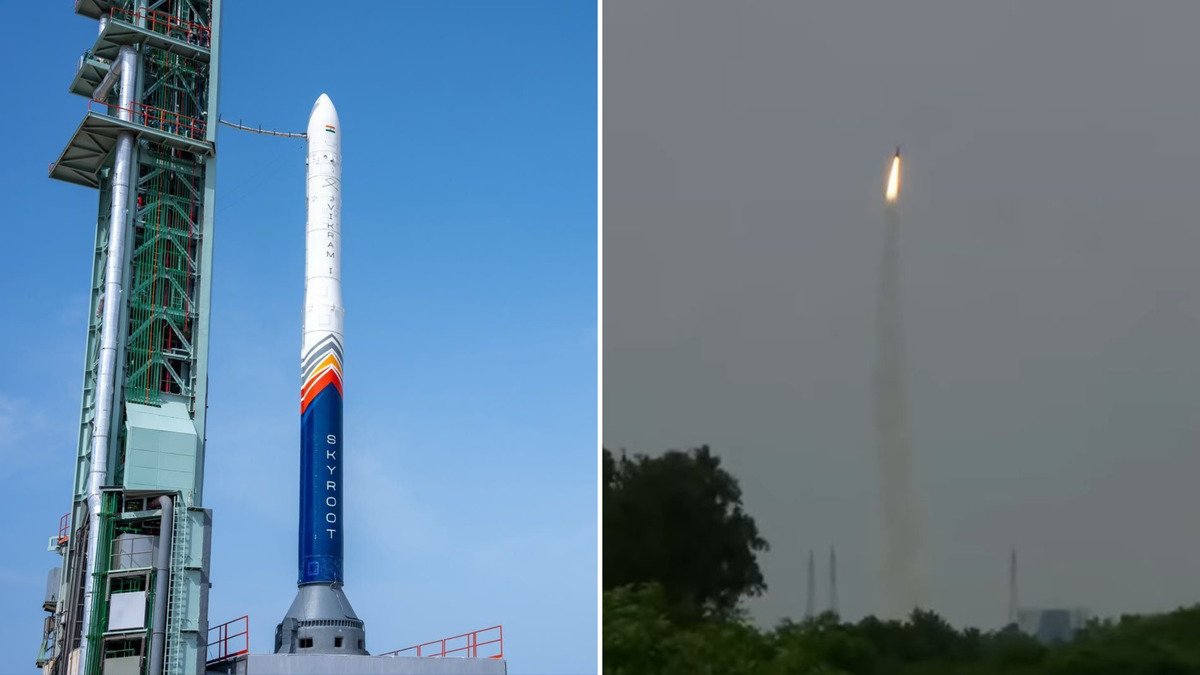
Skyroot Aerospace Vikram-1,
Mission Aagaman, India space
Follow for Helping People.
Use AI for Growth.
About Vikram-1
Vikram-1 was developed by Skyroot Aerospace, a Hyderabad-based private aerospace company, and named after India’s pioneering space scientist, Vikram Sarabhai.
The rocket is a seven-storey-tall, multi-stage orbital launch vehicle built with an all-carbon-composite structure. It is powered by in-house developed propulsion systems, including 3D-printed engines and high-thrust solid-fuel rocket boosters.
Vikram-1 is designed to carry small satellites weighing up to 350 kg to Low Earth Orbit. For this first test flight, the rocket targeted a 450-km orbit at a 60-degree inclination.
Key Specifications
- Height: 22 metres
- Diameter: 1.7 metres
- Design capacity: Up to 350 kg to Low Earth Orbit
- Configuration: Three solid stages and a liquid Orbital Adjustment Module
Payloads Carried by Vikram-1
The rocket carried six technology demonstration payloads on this mission:
- Embrace by Cosmoserve Space
- Solaras Satellite by Grahaa Space
- Scope Satellite by Skyroot Aerospace
- uD3PP and mD3RN by Germany’s Dcubed
- Cosmic Bloom by Cosmos Diamonds
- Micro Art Tribute by Ajay Kumar Mattewada
Regulatory Clearance
Skyroot Aerospace confirmed that all clearances for the launch had been secured from the Indian National Space Promotion and Authorisation Centre (IN-SPACe), the government agency responsible for promoting, permitting, and overseeing private-sector space activities in India.
All stages of Vikram-1 were successfully integrated and stacked on the launch pad, followed by final integrated checks from Skyroot’s launch control centre and interface checks with telemetry ground stations and tracking radars.
Pawan Kumar Chandana, co-founder and CEO of Skyroot Aerospace, said the company had done everything possible to test Vikram-1 on the ground, and was eager to see how the rocket would perform in a real flight environment for the first time. He added that the mission would provide valuable data that would be foundational to Skyroot’s goal of establishing a regular launch cadence.
Mission Objectives
The primary objective of Vikram-1’s first test flight was to achieve a successful lift-off, safe clearance of the launch tower, and gather maximum data throughout the ascent.
The flight sequence from lift-off to orbit injection covered 14 phases, with a total flight duration of 15 minutes and 46 seconds.
Mission Aagaman marks Skyroot Aerospace’s second major mission, following the successful suborbital flight of Vikram-S — the first private rocket to reach space from Indian soil — on November 18, 2022.
The company noted that this was a partially commercial flight, with plans to begin full commercial operations after one or two more successful demonstrations to orbit. The flight-ready Vikram-1 rocket was earlier unveiled by Prime Minister Narendra Modi in November 2025.
Many Firsts for India’s Space Sector
Vikram-1’s successful launch brings several firsts for India:
- India’s first privately developed orbital launch vehicle
- India’s first all-carbon-composite orbital rocket
- India’s first orbital vehicle with a 100% 3D-printed engine
- India’s longest monolithic carbon-composite rocket stage
- First-of-its-kind ultra-low-shock pneumatic separation systems
A Historic Milestone, 46 Years Apart
The launch of Vikram-1 comes 46 years after India’s first experimental Satellite Launch Vehicle, the SLV-3. On July 18, 1980, India became the sixth member of an exclusive club of spacefaring nations when the SLV-3 successfully placed the Rohini Satellite (RS-1) into orbit — from the very same launch site.
A handwritten postcard from Prime Minister Narendra Modi also travelled to space aboard Vikram-1, along with hundreds of postcards from well-wishers around the world.
Prime Minister’s Reaction
Following the successful launch, Prime Minister Narendra Modi spoke by telephone with the Skyroot Aerospace team. In his conversation with co-founder and CEO Pawan Kumar Chandana, he called the launch a defining moment in India’s space journey. He said the growing participation of the private sector is opening new frontiers and accelerating innovation, and that this achievement would encourage countless young people to dream bigger and innovate fearlessly.
Conclusion
The successful launch of Vikram-1 is more than just a single rocket reaching orbit — it represents a turning point for India’s space industry. By becoming only the third country in the world to send a privately built rocket into orbit, Skyroot Aerospace has shown that India’s private space sector can compete on a global scale, not just support the government’s space programme. The mission’s timing, arriving exactly 46 years after India’s first satellite launch from the same site, adds a symbolic weight to an already historic achievement. With core technologies like 3D-printed engines and an all-carbon-composite structure proven in real flight conditions, Skyroot is now positioned to move toward regular commercial launches. For India’s growing space-tech ecosystem, Mission Aagaman is likely to be remembered as the moment private spaceflight truly arrived in the country.
Vikram-1 is India's first privately developed orbital-class rocket, built by Skyroot Aerospace. Its successful launch makes India only the third country in the world to place a privately built rocket into orbit.
Vikram-1 carried six technology demonstration payloads, including satellites from Grahaa Space, Cosmoserve, and Dcubed, along with Skyroot's own Scope Satellite, an artwork piece called "Cosmic Bloom," a micro-art tribute, and postcards including one from Prime Minister Narendra Modi.
Vikram-1 was built by Skyroot Aerospace, a Hyderabad-based private aerospace company. The rocket features an all-carbon-composite structure and is powered by in-house developed propulsion systems, including 3D-printed engines and high-thrust solid-fuel rocket boosters.
Vikram-1 lifted off on July 18, 2026, at 12:05 p.m. from the Satish Dhawan Space Centre in Sriharikota — the same site where India launched its first experimental satellite launch vehicle, the SLV-3, exactly 46 years earlier.
What You Will Master.
- AI Fundamentals & Prompt Engineering
- Automation Tools & No-Code Systems
- AI for Business & Marketing
- Real-World Project Building
- Freelancing & Career Strategy
Apply for Learning
AI Program